
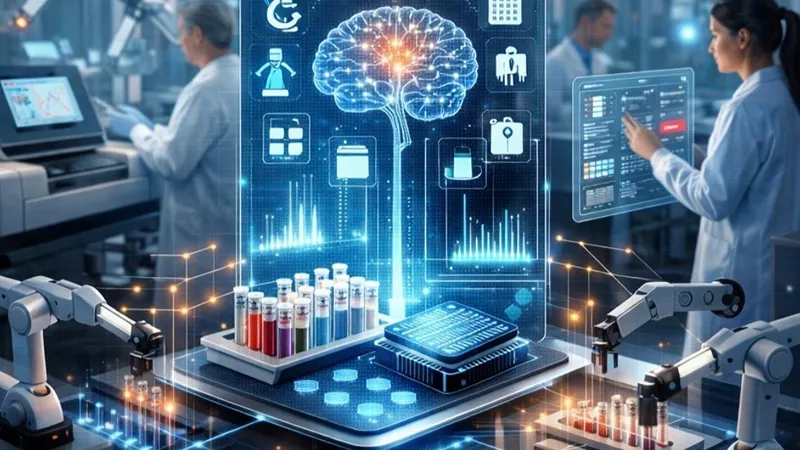
As we begin the New Year, we extend our sincere gratitude to our global customers, technology and platform partners, and colleagues for your continued trust, collaboration, and commitment.
As healthcare and life sciences organizations prepare for 2026 and beyond, my CXO-level conversations increasingly converge on a single imperative: the urgent need to reimagine laboratory IT. What began as discussions around Laboratory Information Management Systems (LIMS) implementation or consolidation has rapidly evolved into a broader, more strategic mandate—modernizing lab ecosystems from the ground up to build intelligent laboratories, not just digitally enabled ones.
This shift is no longer about system upgrades or incremental automation. It is about transforming fragmented lab IT landscapes into unified, AI-driven platforms that can scale science, ensure compliance, and unlock real-time insight. The question facing leaders today is not whether to modernize LIMS, but how quickly they can move from operating digital labs to orchestrating intelligent ones.
Let’s explore what this transformation truly means.
From Digital to Intelligent Labs
Laboratories are no longer just data generators—they are data-driven decision engines. By 2026, the evolution from traditional Laboratory Information Management Systems (LIMS) to AI-native LIMS platforms will define the next era of digital laboratories. Unlike legacy or “AI-enabled” systems that bolt analytics onto existing workflows, AI-native LIMS are designed from the ground up with artificial intelligence at their core, fundamentally reshaping how labs operate, scale, and innovate.
What Is an AI-Native LIMS?
An AI-native LIMS is a laboratory platform where machine learning, automation, and intelligence are embedded into the system architecture, not added as plugins.
Key characteristics include:
- Self-learning workflows
- Predictive analytics by default
- Autonomous data classification and governance
- Continuous optimization of lab operations
In essence, AI-native LIMS move labs from record-keeping systems to decision-making platforms.
Why Traditional LIMS Are No Longer Enough
Most legacy LIMS were designed for:
- Sample tracking
- Compliance documentation
- Manual workflows
However, modern labs—especially in genomics, diagnostics, biopharma, and clinical research—face new realities:
- Terabytes of data generated daily
- Complex multi-omics pipelines
- Strict regulatory and data-privacy requirements
- Pressure for faster turnaround and lower cost
Traditional LIMS struggle with:
- Static workflows
- Manual exception handling
- Reactive quality management
- Limited scalability for AI and cloud-native workloads
Core Capabilities of AI-Native LIMS in 2026
Digitide’s AI-Native LIMS Capability Framework include
1. Intelligent Workflow Orchestration
AI-native LIMS dynamically adapt workflows based on:
- Sample type
- Instrument availability
- Historical success rates
- Regulatory constraints
Instead of predefined SOPs, workflows become context-aware and self-optimizing.
2. Predictive Quality & Compliance
Rather than detecting deviations after they occur, AI-native LIMS:
- Predict OOS and OOT events
- Identify data integrity risks early
- Flag compliance gaps before audits
This shifts quality management from reactive to preventive, a major leap for GxP environments.
3. Autonomous Data Management
With massive data volumes (especially in NGS and digital pathology), AI-native LIMS:
- Automatically classify hot, warm, and cold data
- Optimize cloud storage tiers in real time
- Enforce data retention and archival policies without human intervention
This delivers significant cost optimization while maintaining regulatory compliance.
4. Embedded AI for Scientific Insight
AI-native LIMS integrate directly with:
- Genomic variant interpretation models
- Image analysis algorithms
- Pattern recognition across historical experiments
Scientists spend less time managing data and more time interpreting insights.
5. Human-in-the-Loop Automation
While automation increases, AI-native LIMS ensure:
- Critical decisions remain explainable
- Scientists can override AI recommendations
- Full audit trails for regulatory acceptance
This balance is essential for clinical and regulated laboratories.
AI-Native LIMS and the Cloud-First Lab
By 2026, AI-native LIMS are inherently:
- Cloud-native
- API-driven
- Scalable across global lab networks
They integrate seamlessly with:
- ELN, CDS, QMS, MES, and ERP systems
- Hyperscaler AI services
- Digital twins of lab operations
This enables federated labs and global Centers of Excellence (CoEs).
Security, Ethics, and Trust
AI-native LIMS in 2026 prioritize:
- Explainable AI (XAI)
- Zero-trust security architectures
- Role-based and attribute-based access control
- Compliance with 21 CFR Part 11, HIPAA, GDPR
Trust in AI decisions is as important as accuracy.
The Business Case: Beyond IT Modernization
Adopting an AI-native LIMS delivers:
- 30–50% operational efficiency gains
- Significant cloud cost optimization
- Faster regulatory approvals
- Improved scientific productivity
- Future-proof lab architecture
This is not just a technology upgrade—it’s a strategic transformation.
Summary
AI-native LIMS represent the foundation of autonomous, predictive, and intelligent digital laboratories, enabling organizations to scale science with speed, compliance, and confidence.
The future of labs is not just digital—it is AI-native and Digitide’s AI-Native LIMS Capability Framework can seamless support on this.