
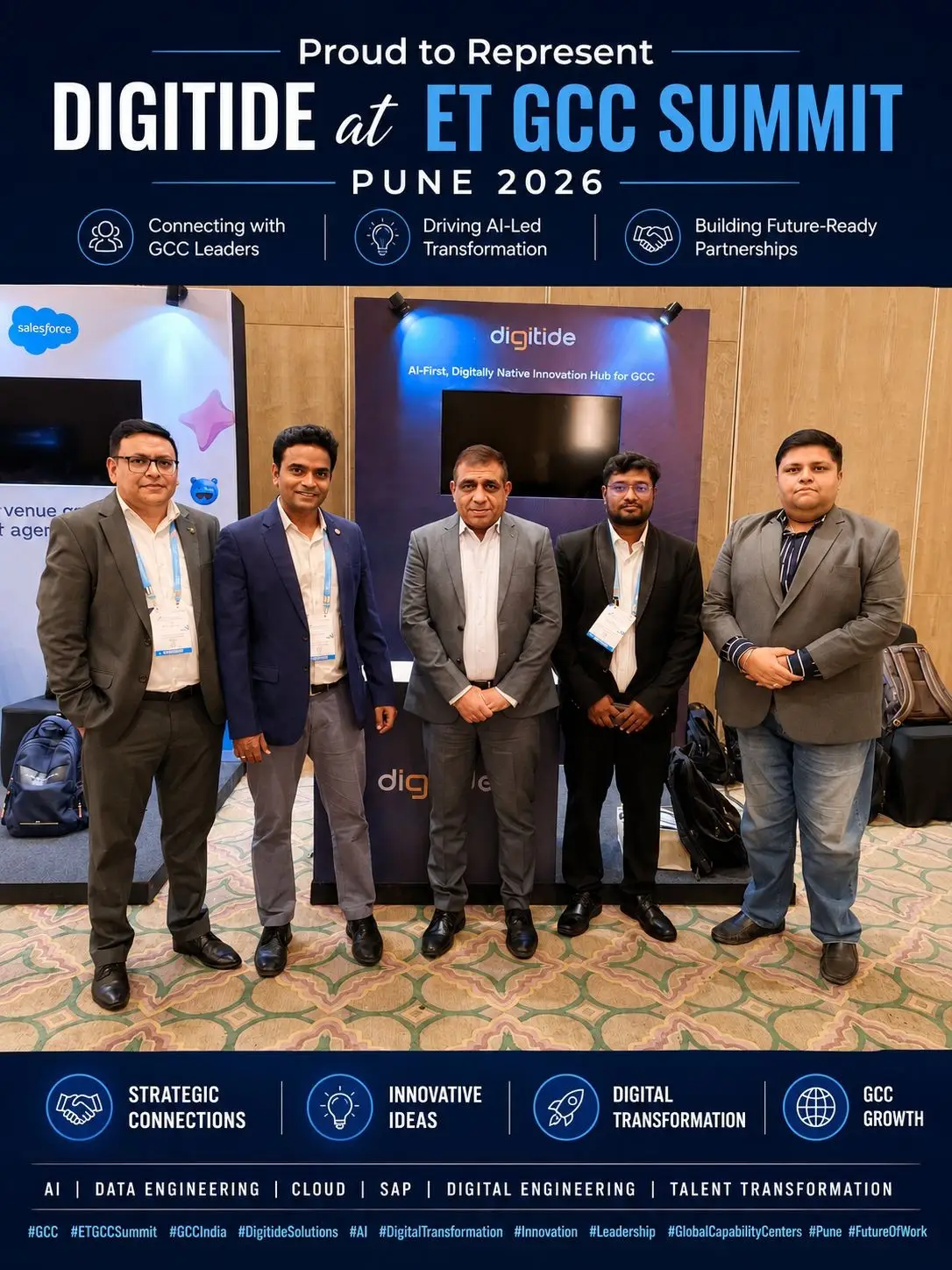
Last week, Digitide had the privilege of partnering with the ET for the GCC World Global Capability Centers (GCC) Growth Summit 2026 event in Pune. The event brought together GCC leaders, enterprise executives, and transformation partners to exchange ideas, share experiences, and shape the roadmap for the next phase of global innovation. One theme stood out consistently across discussions: the evolving role of GCCs from execution-focused delivery centers to innovation hubs, product engineering organizations, and strategic business enablers for their parent enterprises.
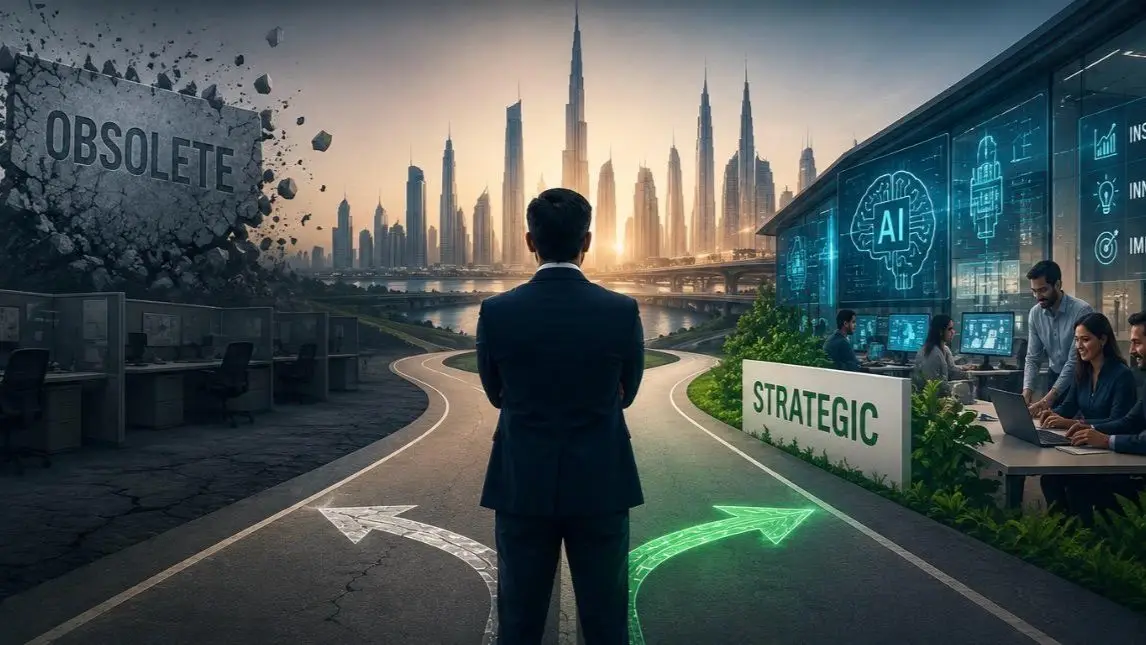
As Artificial Intelligence rapidly transforms how software is built, tested, deployed, and operated, a provocative question is emerging in boardrooms and GCC leadership circles alike: Will AI make GCCs obsolete or will it elevate them to an even more strategic position within the enterprise?
Having spent the past several years helping organizations navigate digital transformation, AI adoption, and engineering modernization, my perspective is clear: AI will not diminish the relevance of GCCs—it will fundamentally redefine their purpose. The future will belong to GCCs that move beyond labor arbitrage and operational excellence to become AI-powered innovation engines, product owners, and enterprise intelligence hubs. Sharing my perspective on this transformation and why the next decade could be the most exciting chapter in the GCC story.
For nearly three decades, Global Capability Centers (GCCs) have been built around a proven formula: access to talent, operational excellence, process maturity, and cost efficiency. Today that formula is being fundamentally challenged. Generative AI, Agentic AI, Autonomous Software Engineering, and AI-powered Business Operations are creating a reality where work that previously required hundreds of engineers, analysts, testers, and support professionals can now be executed by AI-assisted teams at unprecedented speed.
At Digitide, we believe the answer is clear: AI will not make GCCs obsolete. It will make traditional GCC operating models obsolete. The future belongs to GCCs that evolve from delivery centers into Engineering Intelligence Hubs that combine human expertise, AI agents, enterprise knowledge, and digital platforms to accelerate business outcomes.
The End of Labor Arbitrage as a Competitive Advantage
Historically, GCCs differentiated themselves through scale, cost efficiency, talent concentration process standardization and delivery excellence .But AI is fundamentally changing the economics of knowledge work .In AI assisted software development lifecycle, the impact is profound. Organizations are no longer asking “How many engineers do I need?” .They are asking “How much business value can I generate per engineer? “This shift marks the beginning of a new era where GCC success is measured by intelligence amplification rather than workforce expansion.
The Rise of the Engineering Intelligence Organization
At Digitide, we believe the next generation of GCCs will operate as Engineering Intelligence Organizations (EIOs). These organizations will orchestrate human expertise, AI agents, Enterprise knowledge systems, automation platforms, digital workers and predictive analytics. Instead of scaling through headcount, they will scale through intelligence. This transformation is exactly why we developed ARISE (AI Reinforced Software Engineering). ARISE is not another AI coding framework.It is a comprehensive AI-powered engineering operating model designed to infuse intelligence across the entire software lifecycle.
Why ARISE Matters for GCCs
Most organizations are currently experimenting with isolated AI tools viz GitHub Copilot, Claude Code ,Gemini Code Assist ,Cursor , Amazon Q Developer etc. While useful, these tools address only a fraction of the software lifecycle. The real transformation occurs when AI is systematically embedded across the engineering value chain. The ARISE framework enables exactly that.
A – Accelerated Requirements Engineering – AI-powered requirement analysis, user story generation, business process discovery, and impact assessment.
R – Reinforced Architecture & Design – AI-assisted architecture reviews, design recommendations, security validations, and modernization strategies.
I – Intelligent Development – Developers leverage AI agents for code generation, refactoring, unit test creation, vulnerability remediation and documentation generation
S – Smart Quality Engineering – AI-driven testing and quality assurance with autonomous test generation, test optimization, defect prediction and regression automation
E – Enterprise Operations Intelligence – AI-powered DevSecOps, AIOps, and observability with incident prediction, root cause analysis, automated remediation and intelligent monitoring
Agentic AI: The Next Evolution of GCCs
The first phase of AI adoption focused on copilots. The second phase is about agents. Unlike copilots , agents can reason, plan, execute, collaborate, learn and trigger enterprise actions
We at Digitide, see the emergence of a new operating model where AI agents become digital teammates. Imagine a future GCC powered by specialized agents: Business Analyst Agent creating user stories and acceptance criteria, Solution Architect Agent generating solution blueprints and validates design patterns, developer Agent creating production-ready code and remediates vulnerabilities, Quality Agent generating and executing test suites. DevOps Agent automating deployment readiness checks and Operations Agent performing predictive monitoring and incident resolution. Human experts remain accountable, but execution becomes increasingly AI-accelerated. This is not workforce replacement. It is workforce amplification.
The New GCC KPI: Engineering Intelligence Yield – It is a composite measure of Productivity gain from AI, Time-to-market improvement, Defect reduction, Customer experience impact and Innovation velocity
From GCC to Enterprise Innovation Engine
The most successful GCCs of the future will no longer be viewed as cost centers.They will become AI Innovation Hubs ,Product Engineering Centers, Digital Transformation Accelerators and enterprise intelligence platforms .Their mission will extend beyond software delivery to include AI-powered business transformation, CX innovation, platform modernization, data and AI strategy execution and enterprise-wide productivity acceleration .This represents a fundamental shift from execution to value creation.
Summary
At Digitide, we believe the future of GCCs will be defined by a simple principle – The winners will not be those with the largest workforce. The winners will be those with the highest Engineering Intelligence. Through frameworks such as ARISE (AI Reinforced Software Engineering), AI Trust Stack, and our AI-First Digital Engineering approach, we are helping enterprises reimagine how software is built, tested, deployed, and operated in the age of AI. The question is no longer whether AI will transform GCCs. The question is Will your GCC remain an execution factory, or will it evolve into an Engineering Intelligence Hub that powers the next generation of enterprise innovation?